

Best Security Awareness Training Products in 2026
Security Awareness Training Products Overview
Cyberattacks increasingly target people—not just technology. Phishing, social engineering and credential theft remain among the most common entry points for attackers, and studies consistently show that the majority of security incidents involve a human element. As a result, organizations are placing greater emphasis on security awareness training (SAT) as a critical component of their overall cybersecurity strategy.
At the same time, the role of security awareness training is evolving. Traditional programs focused primarily on compliance-driven education, delivering the same static training modules to every employee. In 2026, leading organizations are shifting toward human risk management (HRM)—a more advanced approach that uses behavioral analytics, adaptive training and continuous measurement to actively identify and reduce human-related cyber risk.
This shift is also transforming the capabilities organizations expect from SAT platforms. Security leaders are increasingly evaluating solutions based on their ability to deliver personalized training, realistic phishing simulations, automation and AI-driven program management, and robust analytics that demonstrate measurable risk reduction. Integration with the broader security ecosystem—such as email security, threat intelligence and incident response tools—is also becoming essential.
What you will learn:
- Compare the best security awareness training products in 2026
- Examining how leading platforms stack up across these critical capabilities.
- See the enterprise-scale platforms that offer specialized training solutions
- Get an overview that highlights the strengths, limitations and ideal use cases for the vendors shaping the modern human risk management market.
Critical Capabilities Enterprise Security Awareness Training Platforms Must Provide
Not all security awareness training (SAT) platforms are created equal. As organizations shift from simple compliance training to true human risk management, the capabilities of the platform matter more than ever.
When evaluating enterprise security awareness training solutions in 2026, security leaders should look beyond basic training modules and focus on platforms that can identify, measure and actively reduce human risk.
Adaptive, Personalized Training
Generic training is one of the fastest ways to lose employee engagement. Modern platforms should deliver training that adapts to individual users rather than forcing everyone through the same static course.
Leading solutions analyze user behavior, risk scores and training history to deliver relevant content tailored to each employee. That includes adjusting difficulty levels, presenting targeted learning paths and reinforcing topics where users show higher risk. Personalized training keeps users engaged while ensuring the right people receive the right training at the right time.
Risk-Based User Profiling
Employees do not present the same level of risk. A critical capability of modern SAT platforms is the ability to create dynamic risk profiles for users and groups.
By analyzing behaviors such as phishing susceptibility, reporting rates and training completion, platforms can group employees by risk level. Security teams can then deliver targeted interventions, focusing their time and resources where it matters most.
This approach transforms awareness training from a checkbox exercise into a data-driven risk reduction program.
Intelligent Phishing Simulations
Phishing remains the most common initial attack vector. As a result, phishing simulations are a core component of any SAT platform—but not all simulations are equal.
Advanced platforms use automated variation and intelligent targeting to challenge users with realistic phishing scenarios. Simulations should evolve over time, incorporating emerging attack techniques and adjusting difficulty as users improve.
The goal isn’t to trick employees. It’s to build the real-world skills needed to recognize and report suspicious emails.
Automation and AI-Driven Efficiency
Enterprise security teams are stretched thin. A modern SAT platform should leverage AI and automation to reduce operational overhead.
Capabilities such as automated training assignments, intelligent phishing campaign management and AI-assisted analysis allow security teams to scale their programs without adding manual effort. The best platforms operate as an extension of the security team, helping them run continuous awareness programs with minimal administrative burden.
Robust Reporting and Human Risk Analytics
Security leaders need clear visibility into whether their program is actually reducing risk. That’s why reporting and analytics are essential.
Leading platforms provide detailed insights into user behavior, training effectiveness and organizational risk trends. This includes benchmarking against industry peers, tracking improvement over time and correlating training activity with measurable security outcomes.
When done right, these insights enable organizations to quantify human risk and demonstrate program impact to leadership.
Integration with the Security Ecosystem
Finally, enterprise SAT platforms should integrate seamlessly with the broader security stack. Integration with email security, incident response workflows and threat intelligence helps ensure training reflects real-world threats facing the organization.
By connecting awareness training to actual security events, organizations can continuously refine their programs and reinforce the behaviors that matter most.
Key Features of Top Security Awareness Platforms
1. High-Quality Content & Learning Management
- Diverse Content Library: A mix of interactive modules, high-production-value videos, trivia games, and newsletters to cater to different learning styles.
- Micro-learning: Short, 2-to-5 minute "snackable" modules designed for busy employees and mobile consumption.
- Localization: Content available in multiple languages with culturally relevant translations, not just machine-translated text.
- User Experience: A user-friendly interface where employees can track their own progress, earn badges, and see leaderboards (Gamification).
- Mobile Support: A dedicated app or mobile-optimized browser experience for training on the go.
2. Phishing Simulation & Testing
- Unlimited Simulated Phishing: The ability to run year-round, high-frequency phishing tests without per-campaign costs.
- Extensive Template Library: Access to thousands of real-world templates that are updated daily to reflect current trending threats (e.g., HR policy updates, IT alerts, or "Scam of the Week").
- Customization: Tools to create company-specific phishing simulations, including custom landing pages and "spoofed" internal domains.
- Advanced Testing Methods: Support for diverse social engineering tests, including Vishing (voice), Smishing (SMS), QR Code phishing, and USB drops.
- Phishing Reply Tracking: The ability to track if a user actually replies to a simulated phish, mimicking Business Email Compromise (BEC) attacks.
3. Cloud Email Security
- Behavioral AI and Anomaly Detection: Unlike traditional filters that look for known "bad" signatures, Behavioral AI builds a baseline of "normal" communication for every user. It tracks writing styles, typical login locations, and common recipients to identify subtle anomalies that would otherwise bypass standard security.
- Time-of-Click protection: which re-scans links every time a user clicks them to ensure a once-safe website hasn't been turned into a phishing site after the email was delivered.
- Real-Time Sandboxing: To combat zero-day threats, these platforms use sandboxing to "detonate" suspicious attachments in a safe, isolated environment before they reach the user. This is often paired with
4. AI & Automation
- Agentic AI Agents: Reduce management burden and speed to implementation with dedicated AI agents
- AI-Driven Phishing: Artificial intelligence that automatically selects the best phishing template for each user based on their specific training history and past performance.
- Automated Program Creation: Tools that allow admins to build a fully customized, multi-year training roadmap in minutes based on specific organizational goals.
- Smart Groups: Automated user grouping based on behavior (e.g., "Frequent Clickers" or "Accounting Team") to trigger remedial training or advanced testing automatically.
- AI Recommendations: Machine learning that suggests specific training modules to users based on the types of phishing links they’ve clicked.
5. Advanced Reporting & Risk Analytics
- Executive Dashboards: High-level reporting that tracks the organization's phish-prone percentage over time to show ROI to stakeholders.
- Industry Benchmarking: The ability to compare your organization's security stats against peers of the same size and industry.
- Personal Risk Scores: A dynamic score for every individual user based on their training completion, phishing failures, and reported emails.
- Automated Reporting: Scheduled reports (e.g., weekly or monthly) sent automatically to department heads or IT managers.
6. Integration & Infrastructure
- One-Click Reporting: Allow users to safely report suspicious emails, providing an instant feedback loop.
- Directory Integration: Automated user provisioning via Active Directory, Azure AD, Okta, or SCIM to ensure the user list is always up to date.
- SSO/SAML Support: Seamless login for employees using existing corporate credentials.
- API Access: Robust APIs to export data into SIEM, SOAR, or BI tools for deeper analysis.
7. Culture & Behavior Management
- Security Culture Surveys: Periodic assessments to measure employee sentiment and attitudes toward security, going beyond just "knowledge" tests.
- Real-Time Coaching: Integration with security stacks to deliver "just-in-time" coaching tips when a user performs a risky action (like visiting a blocked site or plugging in an unapproved USB).
- Compliance Support: Dedicated content for regulatory requirements such as GDPR, HIPAA, PCI-DSS, and SOC2.
How The Leading Security Awareness Training Products Compare
Our rankings are based on a combination of independent customer feedback and broader market analysis. We reviewed end-user ratings and commentary from trusted sources including G2 Grid® Reports and Gartner Peer Insights, which provide verified customer perspectives on usability, features, support and overall satisfaction. These insights were combined with an evaluation of platform capabilities—such as personalization, phishing simulation realism, automation, analytics and integrations—along with overall market positioning. By blending real-world customer experience with third-party analysis, this article highlights the security awareness training platforms that deliver the most value for organizations in 2026.
Features Matrix
|
Feature |
KnowBe4 |
Hoxhunt |
Mimecast |
Huntress |
|---|---|---|---|---|
|
Diverse Content Library |
Most diverse content library with over 500+ items including videos, games, posters, and newsletters. |
Limited volume of content and all short form. |
Entertainment-industry quality videos in a sitcom style. Library is small with less variety. |
Narrative-driven "episodes" with consistent characters. |
|
Micro-learning |
Automated follow-up micro-training for clickers. |
Gamified, interactive micro-training. |
Monthly 3–5 minute "doses" of learning. |
Short, consumable lessons. |
|
Localization |
Human reviewed content for 35+ languages across its massive library. |
AI localization in 35+ languages. |
Multilingual content available, but short video options can be limited. |
|
|
Mobile Support |
Fully responsive web-based training. |
Mobile-friendly interactive learning. |
Mobile access supported, though auth can be tricky. |
Web-based access across devices. |
|
Unlimited Simulations |
Frequent, "double-random" phishing tests. |
Dynamic, adaptive simulations based on user behavior. |
Quarterly or continuous monthly simulations. |
Monthly automated phishing simulations. |
|
Template Library |
World's most diverse library of prebuilt templates. |
Focus on realistic, adaptive scenarios over a static library. |
Mimecast’s phishing library is limited and lacks strong randomization or real-world diversity. Admins must manually set up campaigns for each group. |
Curated scenarios based on real-world threat intel. |
|
Customization |
Flexible for various industries and regulatory needs. |
Limited compared to legacy tools; focuses on AI-driven adaptation. |
Branding possible, but less flexible for deep content edits. |
Allows adding your own custom content into the LMS. |
|
Advanced Testing |
AIDA agents for deepfake and callback phishing tests. |
Behavioral science-based tests that adapt difficulty. |
Adaptive simulations linked to actual mailbox threats. |
"Put users in the hacker's seat" via interactive simulations. |
|
Phishing Reply Tracking |
Supported; tracks if users engage with mock phish. |
Built into the gamified reporting/sensor network. |
Part of its "Efficacy reporting" system. |
Tracks responses to simulated scenarios. |
|
Behavioral AI/Detection |
AIDA (AI Defense Agents) for detection and personalization. |
Full AI-driven platform for human risk management. |
AI-powered simulations and adaptive intervention. |
Backed by a 24/7 SOC for real-world threat data. |
|
Time-of-Click/Sandbox |
Integration with PhishER for real-time response. |
Real-time feedback for reported threats. |
Seamless integration with Mimecast's email security gateway. |
Integrated with the broader Huntress security platform. |
|
AI-driven Phishing |
AI-selected templates based on user history. |
Automatically selects templates based on individual risk. |
AI-powered simulations within its "Engage" platform. |
Content based on automated real-world threat intel. |
|
Automated Programs |
ASAP (Automated Security Awareness Program) for custom plans. |
Heavy automation limits administrator control over cadence, content selection, exception handling, and approval workflows—reducing governance in complex environments. |
Mimecast prioritizes automation and ease of deployment |
"Set it and forget it" automated campaign management. |
|
Smart Groups |
Tailor campaigns based on behavior and attributes. |
Smart Groups are AI-driven based on user behavior and attributes but do not support policy-based segmentation, compliance logic, or complex administrative controls. |
Watchlists for grouping users by needs. |
Automated grouping for targeted recovery training. |
|
Executive Dashboards |
Advanced executive-level reports for data-driven decisions. |
Reporting is limited to user behavior and training performance metrics, with no executive, compliance, or SOC-grade dashboards and only basic CSV or cloud exports. |
Limited visibility into user risk and performance trends makes it difficult to measure program impact. |
Clear ROI visibility (e.g., 2-month ROI). |
|
Industry Benchmarks |
Compare scores with others in your specific industry. |
Measures risk reduction against industry averages. |
Measured against millions of industry data points on the Mimecast grid. |
Comparative data for MSPs and their clients. |
|
Personal Risk Scores |
Unique Risk Score per user based on behavior. |
Risk scoring is behavior-based and optimized for gamification and training adaptation rather than enterprise risk aggregation or security operations use cases. |
Individual risk scoring and behavioral tracking. |
Personalized recovery training for at-risk users. |
|
Automated Reporting |
60+ built-in reports; automated delivery. |
Automatically generates reports for leadership. |
Built-in reports for user performance and watchlist data. |
Simplified reporting; some users find it lacks detail. |
|
Directory Integration |
Active Directory (ADI) and SCIM (Azure, Okta, OneLogin). |
Integrates with major email and identity systems. |
Integrated into the Mimecast administration console. |
Multi-tenant onboarding for easy MSP user management. |
|
SSO/SAML Support |
Supported for seamless user and admin access. |
Supports SCIM, Azure AD, Okta, and OneLogin for provisioning and single sign-on. |
Integrated SSO via the Mimecast cloud platform. |
Included for easy administration. |
|
API Access |
Robust User Event API and webhooks. |
Supports GraphQL API and limited SIEM/SOAR integrations, without full SOAR-style orchestration depth. |
Part of the Mimecast developer ecosystem. |
Integrated into the Huntress platform APIs. |
|
Culture Surveys |
Security Culture Survey across 7 dimensions. |
Built-in measures for behavioral change. |
Measures employee attitudes toward security. |
Focuses on building resilience and a security-first mindset. |
|
Real-time Coaching |
Real-time nudges and point-of-risk training. |
Real-time feedback and training nudges. |
Adaptive Intervention with real-time risk visibility. |
Personalized recovery training after simulation failures. |
|
Compliance Support |
Extensive support for industry/regulatory needs. |
Focuses on behavior over "check-the-box" compliance. |
Modules for GDPR, PCI, HIPAA, and more. |
Specific modules for GDPR, PCI, SOC 2, and ISO 27001. |
KnowBe4 Overview
KnowBe4 delivers one of the most comprehensive security awareness and human risk management platforms in the market, combining adaptive training, advanced phishing simulations and deep human risk analytics. Designed for enterprise scale, the platform helps organizations identify, measure and reduce human risk through personalized learning, automation and strong integration with the broader security ecosystem.
Strengths
Extensive Training Content Library – One of the most diverse libraries in the industry, including thousands of videos, interactive modules, games and role-based learning paths covering security awareness, compliance and specialized topics.
Advanced Phishing Simulations – Highly configurable phishing simulations with automated targeting, evolving difficulty levels and realistic templates designed to mirror real-world attack techniques.
Human Risk Analytics & Benchmarking – Robust reporting, risk scoring and benchmarking tools provide clear visibility into organizational risk and help security leaders demonstrate measurable program impact.
Automation & Program Scalability – Automated campaign management, training assignments and reporting help security teams run large-scale awareness programs with minimal administrative overhead.
Integrated Human Risk Management Platform – KnowBe4 extends beyond traditional SAT with capabilities that connect training, phishing simulations, reporting and human risk insights into a unified platform designed to continuously reduce human-related cyber risk.
Things to Consider
Platform Depth Can Increase Complexity – The breadth of capabilities and options can require additional planning and program management.
Human Risk Management Platform – The scope and feature set may exceed the needs of some organizations.
Bottom Line
KnowBe4 offers the most mature and comprehensive human risk management platforms available, combining deep content, advanced phishing simulations and powerful analytics. Its enterprise capabilities and global scale make it well suited for organizations seeking measurable reductions in human cyber risk.
Arctic Wolf Overview
Arctic Wolf offers a fully managed security awareness training program delivered through its Concierge Security® Team. The service handles campaign management, reporting and administration, making it appealing for organizations that prefer a hands-off approach. It also integrates closely with Arctic Wolf’s broader threat detection and response services.
Strengths
- Fully Managed Service – The Concierge Security® Team manages campaigns, reporting and administration, reducing the need for internal program management.
- Bundled Security Offering – Security awareness training is often packaged with Arctic Wolf’s broader MDR and security services, which can simplify procurement and vendor management.
- Integrated Security Ecosystem – The platform aligns closely with Arctic Wolf’s detection and response tools, providing a unified experience for organizations already using its security services.
Things to Consider
- Training Library Scope – Organizations with specialized compliance or role-based training requirements may want to review the breadth of available content.
- Program Customization – Because the program is delivered as a managed service, there may be less direct control over campaign configuration, templates and workflows.
- Advanced Simulation Capabilities – Some organizations may look for additional capabilities such as adaptive learning, AI-driven simulations or expanded phishing scenario customization.
- Integration Options – Integrations outside of the Arctic Wolf ecosystem may be more limited depending on the organization’s broader technology stack.
- Global Language Support – Organizations operating across multiple regions may want to review available language options.
Bottom Line
Arctic Wolf can be a good fit for organizations seeking a fully managed security awareness program with minimal administrative effort, particularly those already using its broader security services. Organizations looking for deeper customization, expanded content libraries or broader global capabilities may want to compare additional platforms.
Hoxhunt Overview
Hoxhunt provides a gamified security awareness platform focused on phishing simulations and automated, behavior-based training. Its AI-driven personalization and engagement features make it appealing for lean security teams looking for a low-administration program centered on phishing awareness.
Strengths
- User Engagement – Leaderboards, badges, quests and progress tracking encourage strong participation and user engagement.
- Personalization – The platform adapts phishing simulations based on user behavior, risk signals and threat intelligence.
- Deployment – HRIS integrations simplify user management, and automated remediation tools can remove reported phishing emails.
Things to Consider
- Program Flexibility – Some organizations may want greater control over campaign cadence, approvals and training configuration.
- Enterprise Certifications & Standards – Teams with strict compliance or certification requirements may want to review available standards and SCORM support.
- Integration Breadth – Integration options with broader SOC, SOAR or security platforms may be more limited.
- Content Scope – Organizations seeking broader training topics beyond phishing and microlearning may want to evaluate the overall content library.
- Reporting Depth – Security leaders may want to review reporting capabilities to ensure they meet executive visibility and audit reporting needs.
Bottom Line
Hoxhunt is well suited for organizations seeking a highly engaging, phishing-focused training platform. Organizations looking for broader training coverage, deeper integrations or advanced reporting may want to compare additional enterprise SAT platforms
MetaCompliance Overview
MetaCompliance provides security awareness and compliance training with a strong focus on European regulatory requirements. The platform combines localized content, AI-assisted phishing simulations and Microsoft Teams integration, making it appealing for organizations looking to align training with EU data protection and compliance initiatives.
Strengths
- Localized Compliance Content – Strong coverage of regulations such as GDPR, NIS2 and UK Data Protection, with role-based training and support for 40+ languages.
- Phishing Simulations – Tools like the AI Phish Generator and automated scoring help streamline phishing program management.
- Teams Integration – Training, policy acknowledgments and phishing simulations can be delivered directly through Teams.
Things to Consider
- Enterprise Feature Depth – Organizations with mature security programs may want to evaluate advanced capabilities such as real-time coaching or deeper automation.
- Campaign Management – Some training campaigns, segmentation and reporting may require more manual configuration.
- Content Variety – Teams seeking highly dynamic or continuously evolving training formats may want to review the overall content library.
- Administration Experience – Program setup and management may require additional administrative effort.
- Phishing Simulation Coverage – Simulations primarily focus on email-based scenarios rather than broader phishing channels.
Bottom Line
MetaCompliance can be a good fit for organizations seeking compliance-focused security awareness training with strong EU regulatory alignment and Microsoft Teams integration. Organizations looking for broader enterprise automation or multi-channel phishing simulations may want to evaluate additional platforms.
NINJIO Overview
NINJIO delivers short, animated security awareness training episodes designed to make cybersecurity topics engaging and easy to consume. Its story-driven format and simple platform make it appealing for organizations looking for visually engaging training with minimal administrative effort.
Strengths
- Bite-Sized Content – Animated, story-driven episodes under five minutes help capture user attention and improve retention.
- Simple Platform – The platform is designed to be easy to deploy, with minimal setup and ongoing management.
- Automated Training Plans – Recommended monthly training content can be deployed out of the box.
Things to Consider
- Content Variety – Organizations may want to review the breadth of available training topics for long-term program needs.
- Content & Localization Access – Some training content, phishing simulations or language options may be available through additional packages.
- Learner Experience – Teams may want to evaluate how users access training and track their progress across the platform.
- Administrative Experience – Program setup and navigation may require some initial familiarization for administrators.
- Reporting Capabilities – Organizations with advanced reporting requirements may want to review available analytics and stakeholder reporting tools.
Bottom Line
NINJIO is well suited for organizations seeking visually engaging, short-form security awareness training that is easy to deploy and maintain. Organizations looking for broader content libraries, deeper reporting or enterprise-scale capabilities may want to evaluate additional platforms.
Phished.io Overview
Phished.io provides AI-driven security awareness training focused on behavior-based learning and risk scoring. Its platform emphasizes simple deployment and adaptive microlearning, making it appealing for organizations looking for a modern, easy-to-manage awareness program.
Strengths
- Personalization – Training adapts to individual user behavior and risk signals to deliver more targeted learning experiences.
- Deployment & Scoring – Clear metrics and a lightweight setup process make it easy to launch and manage a program.
- Modern Microlearning Content – Short, visual training modules are designed to engage users and fit easily into busy workdays.
Things to Consider
- Content Library Scope – Organizations may want to review the breadth and variety of training topics available for long-term program needs.
- Scoring Transparency – Teams may wish to evaluate how risk scores are generated and how easily insights translate into actionable guidance.
- Reporting & Analytics – Security leaders may want to review reporting capabilities for benchmarking, executive visibility and program measurement.
- Enterprise Capabilities – Organizations with complex environments may want to assess available administrative controls and integrations.
- Security Ecosystem Integration – Integration options with SIEMs and broader security platforms may be more limited.
Bottom Line
Phished.io can be a good fit for organizations seeking an easy-to-deploy, AI-driven security awareness platform with modern microlearning content. Organizations with larger, more complex environments may want to compare additional platforms with deeper enterprise capabilities and reporting.
SoSafe Overview
SoSafe delivers security awareness training built around behavioral science, AI-assisted guidance and role-based learning. The platform focuses on improving user engagement through personalized training and modern program management tools, making it appealing for organizations looking to promote positive security behaviors with relatively low administrative overhead.
Strengths
- Behavioral Insights – Tools such as Sofie Copilot and Human Risk OS™ provide guidance and behavior-based insights designed to support user decision-making.
- Role-Based, Personalized Training – Programs can be tailored to job roles and learning styles, helping deliver more relevant training experiences.
- Modern User Experience – Automated reminders, onboarding support and a streamlined interface help simplify program management.
Things to Consider
- Content Library Scope – Organizations may want to review the breadth of available training topics to ensure alignment with long-term program needs.
- Program Customization – Campaign workflows and program structures may offer less flexibility compared with some platforms.
- AI Capability Maturity – Teams may want to evaluate how AI features support automation and insights across the platform.
- Integration Setup – Integration with other systems may require additional configuration depending on the environment.
- Administrative Setup – Initial program configuration and management may require planning, particularly for larger deployments.
Bottom Line
SoSafe can be an option for organizations seeking behavior-focused security awareness training with modern engagement features and AI-assisted guidance. Organizations with broader enterprise requirements may want to compare platforms offering deeper content libraries, customization and integration capabilities.
Contenders
Abnormal Overview
Abnormal AI focuses primarily on email threat detection and behavioral analytics. The platform helps organizations identify sophisticated threats such as business email compromise and account takeover while maintaining a lightweight deployment model with minimal administrative overhead.
Strengths
- Threat Detection – Behavioral AI is designed to detect complex threats such as business email compromise, account takeover and payload-less phishing
- Low Administrative Overhead – API-based deployment allows organizations to implement the platform quickly with minimal ongoing management
- Automation – Automated remediation and AI-based coaching tools help reinforce user awareness while supporting efficient threat response
Things to Consider
- Security Awareness Training Scope – Organizations seeking a comprehensive security awareness or compliance training program may want to evaluate the depth of available training content
- Simulation Capabilities – Teams interested in extensive phishing simulation programs may want to review available testing and configuration options
- Reporting & Analytics – Security leaders may want to review reporting features for behavioral insights, benchmarking and executive-level visibility
- Customization Options – Organizations may want to assess how AI coaching messages and training communications can be tailored to their environment
Bottom Line
Abnormal AI is well suited for organizations focused on advanced AI-driven email threat detection with minimal administrative overhead. Organizations looking for a comprehensive security awareness training program may want to evaluate dedicated SAT platforms alongside email security solutions.
Adaptive Security Overview
Adaptive Security provides security awareness training with a focus on realistic phishing simulations. The platform emphasizes emerging attack scenarios, helping organizations expose users to a wide range of social engineering techniques.
Strengths
- Multi-Channel Simulations – Training scenarios can include email, SMS, voice and callback phishing, along with emerging formats
- Customizable Content – Visually engaging training materials can be tailored to help keep programs current and relevant
- Pricing – Frequent feature updates and flexible pricing options make the platform attractive for organizations exploring newer training approaches
Things to Consider
- Program Automation – Some training campaigns may require more manual coordination compared with platforms offering continuous risk-based automation
- Learner Engagement Features – Organizations may want to evaluate engagement tools such as gamification or progress tracking for long-term learning continuity
- Learning Management Capabilities – Teams with formal training requirements may want to review LMS features such as certification tracking or role-based workflows
- Compliance Coverage – Organizations with strict regulatory training needs may want to confirm the availability of structured compliance pathways
- Reporting & Metrics – Security leaders may wish to review available analytics and executive reporting tools for measuring program effectiveness
Bottom Line
Adaptive Security is a new player with few customers and can be a good option for organizations interested in multi-channel phishing simulations and engaging training content. Organizations seeking deeper automation, compliance frameworks or enterprise-scale reporting may want to compare additional security awareness platforms.
Barracuda Networks Overview
Barracuda offers security awareness training bundled with its email security and compliance solutions. This integrated approach can appeal to organizations looking to consolidate vendors and simplify procurement, particularly those already using Barracuda’s broader security platform.
Strengths
- Bundled Security Offering – Security awareness training is included alongside Barracuda’s email security and encryption products, helping reduce vendor complexity
- Cost-Conscious Pricing – Bundled pricing and platform consolidation can make the solution attractive for organizations focused on budget efficiency
- Easy Adoption for Existing Customers – Organizations already using Barracuda services may find it straightforward to extend their deployment to include awareness training
Things to Consider
- Training Content Variety – Organizations may want to review the size and variety of the training library to ensure it meets long-term program needs
- Administrative Effort – Program management and campaign setup may require additional manual effort compared with more automated platforms
- Reporting & Analytics – Security leaders may want to review available reporting capabilities for measuring user risk and program effectiveness
- Advanced Simulation Features – Teams interested in adaptive learning or AI-driven phishing simulations may want to evaluate available capabilities
- Global Language Support – Organizations with multilingual workforces may want to confirm available localization options
Bottom Line
Barracuda can be a convenient option for organizations already invested in its email security ecosystem and looking to add basic security awareness training. Organizations seeking deeper automation, email security that doesn’t miss common threats, advanced phishing simulations or broader enterprise capabilities may want to evaluate additional platforms.
Living Security Overview
Living Security provides behavior-focused security awareness training designed to engage users through content and interactive learning experiences. The platform combines training, behavioral nudges and multi-channel simulations to help organizations reinforce positive security behaviors.
Strengths
Behavior-Based Personalization – Training and security nudges can adapt based on user behavior and risk signals.
Immersive Learning Experiences – Interactive formats such as CyberEscape and live-action training series are designed to increase user engagement.
Multi-Channel Simulations – The platform supports simulations and security messaging across email and collaboration platforms such as Teams and Slack.
Things to Consider
Program Automation – Campaign setup and program orchestration may require more manual configuration compared with more automated platforms.
Reporting Capabilities – Organizations may want to review reporting tools for executive dashboards and flexible data analysis.
Scalability – Teams with large or globally distributed workforces may want to evaluate deployment and localization options.
Integration Dependencies – Some behavioral insights may rely on integrations with other platforms.
Bottom Line
Living Security can be an option for organizations looking to deliver creative, immersive security awareness training experiences. Organizations seeking experience, deeper automation, advanced reporting or enterprise-scale deployment capabilities may want to compare additional platforms.
Mimecast Overview
Mimecast offers security awareness training alongside its email security. This bundled approach can make it easy for existing Mimecast customers to extend their security programs with integrated awareness training.
Strengths
Bundled Security Platform – Security awareness training is included with Mimecast’s email security, archiving and continuity services, helping simplify vendor management.
Cost-Conscious Option – Bundled pricing and streamlined renewals can make the solution appealing for organizations focused on budget efficiency.
Simple Training Delivery – Short, video-based modules are easy to deploy and designed to introduce users to key security concepts.
Things to Consider
Training Content Variety – Organizations may want to review the size and diversity of the training library for long-term program needs.
Program Automation – Campaign scheduling, assignments and tracking may require more manual administration compared with more automated platforms.
Training Integration – Teams may want to evaluate how phishing simulation insights connect with user training and behavior improvement.
Reporting & Analytics – Security leaders may wish to review available reporting tools for measuring user risk and program effectiveness.
Bottom Line
Mimecast can be a convenient option for organizations already using its email security platform and looking to add basic awareness training. Organizations seeking broader content libraries, deeper automation or advanced analytics may want to compare additional security awareness platforms.
Why Is Security Awareness Training Evolving Into Human Risk Management
Human risk remains one of the leading causes of cybersecurity incidents. Despite major investments in technical defenses, most breaches still involve human error, misuse or social engineering. Multiple studies estimate that 70% to 90% of breaches include a human element, and nearly three-quarters of CISOs now consider human error their top cybersecurity risk. As a result, organizations are rethinking how they address the human side of security.
For years, the primary approach was security awareness training (SAT). SAT focuses on educating employees about cyber threats, company policies and security best practices. Programs typically include training modules, quizzes and simulated phishing campaigns designed to help employees recognize attacks such as phishing, malware and social engineering. These initiatives play an important role in building a baseline level of security awareness across the organization.
However, awareness alone does not always lead to safer behavior. Employees may understand security guidance in theory but still make risky decisions in practice.
Human Risk Management (HRM) represents the next evolution in addressing human-related cybersecurity risk. Rather than focusing solely on education, HRM takes a broader, data-driven approach to identifying, measuring and reducing human risk.
HRM shifts the focus in several key ways:
- From awareness to measurable risk reduction
- From one-size-fits-all training to personalized learning
- From static programs to continuous, adaptive defense
- From compliance-driven activities to behavior-focused outcomes
- From reactive responses to proactive risk management
Importantly, HRM also reflects a change in mindset. Instead of viewing employees as the “weakest link,” HRM recognizes them as a critical layer of defense when supported with the right insights, guidance and reinforcement.
Security awareness training remains an important foundation. But human risk management expands that foundation into a continuous, measurable strategy for reducing human-related cyber risk.
Security Awareness Training Resources
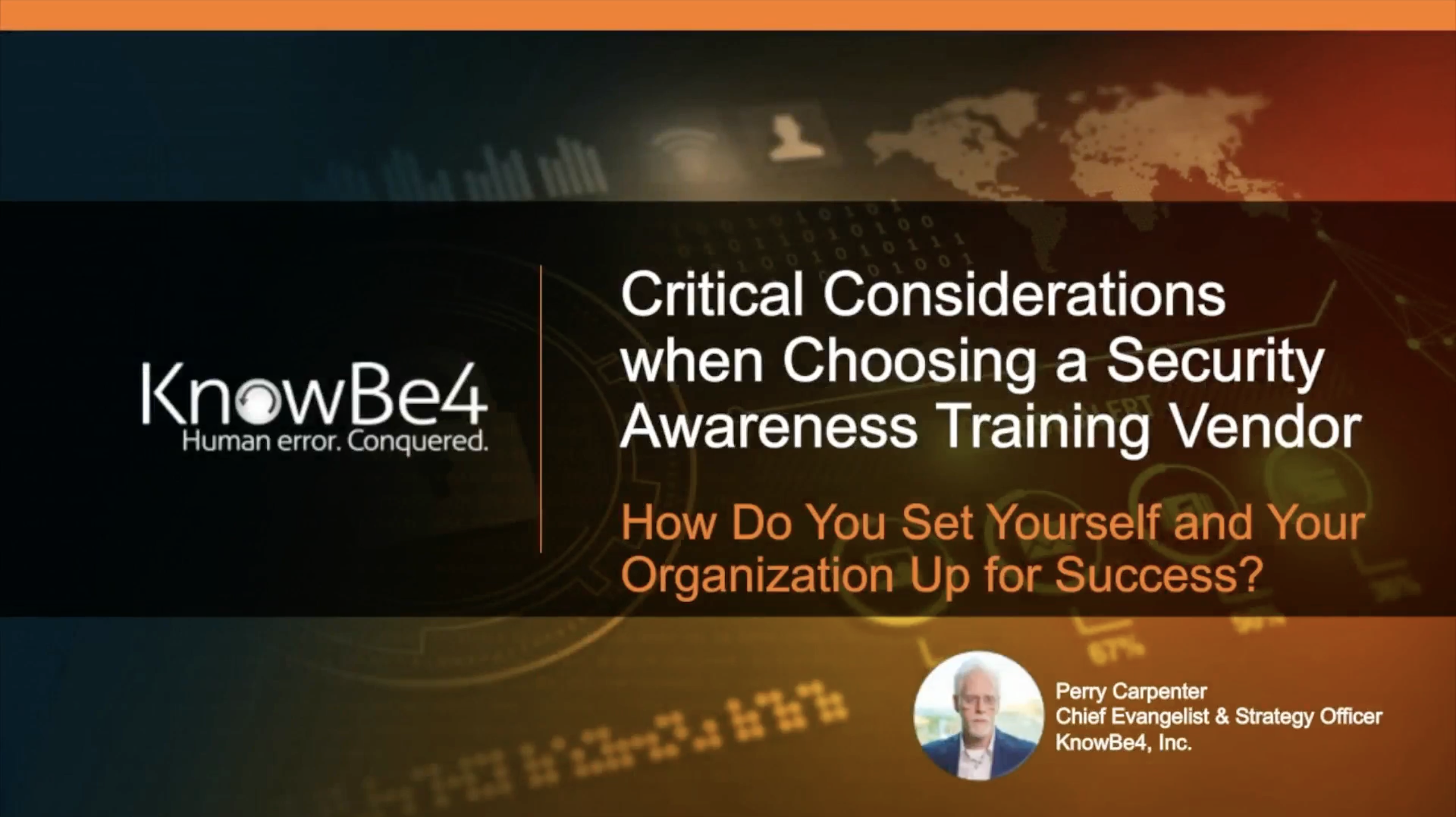
Critical Considerations When Choosing Your Security Awareness Training Vendor
How do you set yourself and your organization up for success?

Training Preview
Browse 1,000+ modules, videos, and games in our massive training library.

Automated Security Awareness Program
Answer 7 questions to build a custom security roadmap and training schedule in minutes.
Frequently Asked Questions
What is security awareness training?
Security awareness training (SAT) is a program designed to educate employees about cybersecurity threats and safe digital behavior. Traditional SAT programs focus on teaching employees how to recognize risks such as phishing emails, social engineering, malware and unsafe data handling practices through training modules, quizzes and simulated phishing campaigns.
However, modern security programs are moving beyond basic awareness toward human risk management (HRM). HRM platforms combine training with behavioral analytics, risk scoring and adaptive learning to actively measure and reduce human-related cyber risk. Instead of simply educating employees, these systems continuously identify risky behaviors and reinforce safer actions over time.
Why is security awareness training important for organizations?
Human behavior remains one of the largest drivers of cybersecurity incidents. Studies consistently show that 70% to 90% of breaches involve a human element, such as phishing clicks, credential theft or accidental data exposure. Even organizations with strong technical defenses can still be compromised if employees are not prepared to recognize and report threats.
Security awareness training helps address this risk by teaching employees how to identify suspicious activity and respond appropriately. Modern programs go further by continuously reinforcing safe behavior through simulations, personalized training and risk-based interventions. When implemented effectively, security awareness training transforms employees from potential vulnerabilities into an active layer of organizational defense.
What features matter most in security awareness training products?
In 2026, security leaders should look for platforms that go beyond static training modules and support continuous human risk management. Key capabilities include adaptive, personalized training that adjusts content based on user behavior, as well as risk-based profiling that identifies employees who are more susceptible to threats.
Modern platforms should also include intelligent phishing simulations, strong automation and AI capabilities, and robust reporting that helps security teams measure real risk reduction over time. Integration with the broader security ecosystem—such as email security, incident response and threat intelligence tools—is equally important so training programs reflect the real-world threats facing the organization.
How is security awareness training different from human risk management?
Traditional security awareness training focuses primarily on educating employees through periodic courses and phishing simulations. While this approach helps build baseline knowledge, it often relies on one-size-fits-all training and does not provide deep visibility into actual user risk.
Human risk management (HRM) takes a broader, data-driven approach. HRM platforms continuously analyze user behavior, risk scores and threat activity to identify where risk exists and automatically deliver targeted interventions. Instead of static training events, HRM programs operate as continuous defense systems, helping organizations measure and reduce human-related cyber risk over time.
How does security awareness training reduce cyber risk?
Security awareness training reduces cyber risk by teaching employees how to recognize and respond to common attack techniques such as phishing, social engineering, credential theft and malicious links. Because many cyber incidents begin with human interaction—clicking a phishing email, sharing sensitive data or using weak passwords—educating employees helps prevent these mistakes before they lead to a breach. Training programs typically combine short learning modules with simulated phishing campaigns to reinforce practical skills, helping users build the awareness needed to identify suspicious activity and report it quickly.
Modern security awareness platforms go further by using behavioral analytics and risk scoring to continuously measure and reduce human risk across the organization. Instead of delivering the same training to everyone, leading platforms analyze user behavior—such as phishing susceptibility, reporting rates and training performance—to provide targeted interventions where risk is highest. This personalized, data-driven approach transforms awareness training from a periodic compliance exercise into a continuous security control that actively reduces the likelihood of successful attacks.
How do phishing simulations help improve security awareness training?
Phishing simulations are a core component of most security awareness programs because phishing remains the most common initial attack vector. Simulated attacks allow employees to practice identifying suspicious emails, credential theft attempts and other social engineering tactics in a safe environment.
Modern SAT platforms go beyond basic simulations by using automation and behavioral analytics to create realistic, evolving attack scenarios. Intelligent simulations adjust difficulty based on user performance and incorporate emerging attack techniques, helping employees develop practical skills for recognizing and reporting threats in real-world situations.
Reduce Human Risk With AI-Native Security Awareness Training
See how KnowBe4 helps organizations strengthen security culture, automate security awareness operations, and reduce phishing-driven risk with AI-native training and intelligent automation.